Damage side, any hour
Mold Remediation
Inspection, containment and air control, safe removal and verification, then the rebuild by the same crew in Farmington and southeast Missouri.
Chapter 01
Finding the source before touching the mold
Mold is a symptom. It grows where moisture lingers: behind a leaking fixture, along a foundation wall, in a crawlspace that never dries out, in drywall that got wet and was never opened up. Taking it off the surface without fixing the water behind it only buys a few weeks. So mold inspection and assessment comes first. We look at what is visible, trace where the moisture is coming from and work out how far the growth has gone into framing, insulation and finishes.
Across Farmington and southeast Missouri, a lot of these jobs start in basements, block walls and crawlspaces, where the air stays damp for months at a time. Knowing what is actually inside the wall tells us whether this is a surface cleaning or a section that has to come out. That answer shapes everything after it, from how large the containment needs to be to how much of the wall the rebuild crew will have to replace, so we would rather spend the time on it up front than discover it halfway through the removal.
Containment and air control come next, before anything is disturbed. Mold work stirs spores into the air, so the work area is sealed off and the air is controlled to keep spores from drifting into the rest of the building. Our process includes containment measures that protect the people living or working in the building during treatment, which is why remediation can go ahead in an occupied home or business. For families that means they can ask how the area will be separated from the rest of the building and get a plain answer before work begins.
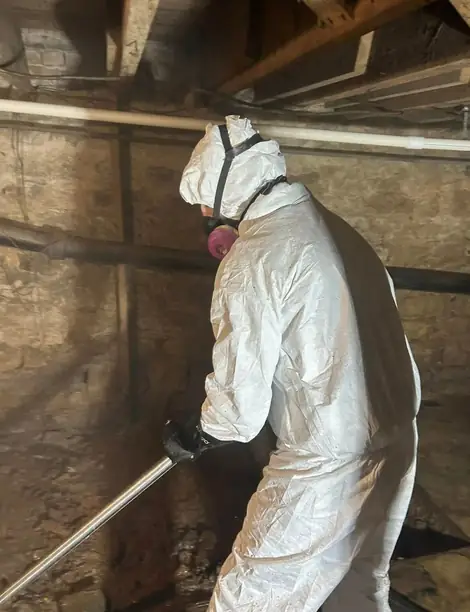
Technician in a full white suit and respirator working in a stone-walled crawlspace
Taking it out without spreading it
Safe mold removal means taking out what is contaminated and cleaning what can be saved, inside that containment, in a set order. Materials that can't be cleaned, like saturated drywall or insulation, are cut out and bagged for disposal. Framing and other solid materials are cleaned in place. The aim is a building left cleaner than we found it, with nothing carried out on boots or through the rest of the house. The area is cleaned again before containment comes down.
Then the moisture has to be dealt with, because removal on its own does not stop a return. Structural drying and dehumidification uses the same discipline as a water loss: air movement, dehumidifiers and meter readings that show when the framing and subfloor have come down to a dry reading. Mold needs moisture to grow, and a dry structure takes that away. We keep taking readings until the numbers show the materials are where they should be, and we do not stop at the point where a wall only feels dry to the hand.
If the moisture came from a leak or a water loss that is part of an insurance claim, we work alongside your adjuster and coordinate the drying so the paperwork and the work line up. The line is open 24 hours, 7 days, so a moldy basement discovered on a Sunday night does not have to wait for Monday.
Chapter 03
Treating the surfaces and confirming the result
After removal, antimicrobial treatment goes onto the cleaned surfaces and framing to deal with what the cleaning left behind. It is one step in a sequence, not a substitute for removal or for drying, and it only works on surfaces that have been cleaned and dried first.
Post-remediation verification is the step that closes the job. We check the treated area and confirm the work did what it was supposed to do before anything is covered back up. Closing walls over unverified work is how mold comes back, so verification stays a step on every job.
What happens after that is where one company matters. Our reconstruction crew rebuilds what had to come out: framing, drywall, flooring and bathrooms, with ventilation and moisture control built in so the problem does not return. Homeowners and businesses across Farmington, St. Francois County and the surrounding towns get the same sequence from the same people. We are licensed and insured, with over 25 years of experience, and estimates are free. Call (573) 631-8495 and we will talk through what you are seeing and set up the inspection.
Licensed and insured. Open 24 hours. Call (573) 631-8495.
Contained and cleared, then rebuilt dry
Remediation ends when the area is verified. The rebuild begins with the moisture problem already solved, and our own framers and finish crews do the work.
This side
The six steps of remediation.
- Mold Inspection and Assessment
- Containment and Air Control
- Safe Mold Removal
- Structural Drying and Dehumidification
- Antimicrobial Treatment
- Post-Remediation Verification
Then the rebuild side
Our own crew, same company.
- Framing
Wall and floor framing rebuilt where moisture and growth had reached the structure.
- Bathroom Remodels
Rebuilt with ventilation and moisture control solutions so the room can dry out between uses.
- Flooring
Subfloor assessed and prepared before any new floor goes down.