Damage side, any hour
Water Damage Restoration
Water extraction, structural drying and moisture mapping across Farmington and southeast Missouri, then the repairs by the same crew.
Chapter 01
Pulling the water out before it spreads
Water does its worst work early. A supply line lets go, a water heater fails or a storm pushes rain through a wall, and the water starts moving along the subfloor, wicking up drywall and getting under cabinets and baseboards where nobody can see it. That is why the first job at a Farmington or southeast Missouri home is emergency water extraction: getting the standing water out so the structure stops soaking it up. The line at (573) 631-8495 is answered any hour of the day or night, seven days a week, because a flooded kitchen at two in the morning is still a flooded kitchen at six.
Extraction is only the first half of the dry-out. Structural drying and dehumidification is the slower work that follows: air movers pushing moving air across floors and through wall cavities, and dehumidifiers pulling the moisture out of that air so it does not settle somewhere else. Hardwood, vinyl plank, carpet and subfloor release water at different speeds, so the equipment is placed for the room in front of us instead of from a fixed pattern, then checked and moved until the materials are actually dry. A drying job is a series of visits, not a single drop-off of equipment, and each visit ends with a reading that tells us whether to keep going or pull the machines out.
If the loss is covered, say so on the first call. We understand insurance policies, documentation and the claims process, and we work alongside your adjuster on water claims, so the paperwork is kept up while the work happens instead of rebuilt from memory afterward.
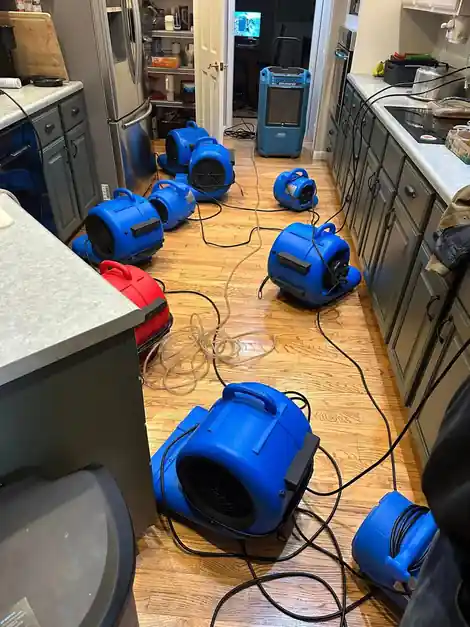
A kitchen full of blue air movers and a dehumidifier drying the hardwood floor
Mapping the moisture you can't see
A wall that feels dry to the hand can still be holding water behind the paint. Moisture detection and mapping is how we find out. Moisture meters, thermal imaging and hygrometers let us trace where the water went, read how wet each material really is and record the humidity in the air. The result is a map of the loss: which rooms, which walls, which stretch of floor. That map decides what has to come out, what can be dried in place and where the equipment goes.
It keeps the job honest in both directions. Readings taken at the start show an adjuster the full extent of the damage, and readings taken as the job goes show when a room has reached the point where the equipment can come out. Nobody is guessing whether a subfloor is dry before new flooring goes over it. For a homeowner, that record is also the clearest answer to the question of when the house is safe to close back up.
Not every water loss is clean water. Contaminated water cleanup covers Category 2 and Category 3 water, the kind that comes from a washing machine or dishwasher line, a toilet overflow, a sewer backup or flooding that came in from outside. Those losses need the affected materials removed and the surfaces cleaned and treated, not just dried. The same crew handles it, with a plan for what gets discarded and what can be saved. Residents and tenants stay informed about what is happening in their building and why, because a loss like this is stressful enough without surprises.
Chapter 03
Contents, repairs and the rebuild after
Furniture, rugs, boxes and keepsakes sit in the path of every water loss. Contents drying and protection means moving what can be saved out of the wet zone, drying it and protecting it while the structure dries, so the damage list does not grow while the work goes on.
Then comes repair coordination and restoration, and this is where being one company matters. With over 25 years of experience and our own reconstruction crew, the people who dried the house are the ones who work out what has to be rebuilt: the subfloor, the flooring on top of it, a section of drywall, a kitchen that was opened up to get at the water. There is no handoff to a stranger who has to start by learning what happened.
Homes and commercial properties across Farmington, St. Francois County and the towns around it get the same sequence: extract, dry, map, confirm, rebuild. We are licensed and insured, estimates are free, and the first step is a phone call.
Licensed and insured. Open 24 hours. Call (573) 631-8495.
Dried out on one side, rebuilt on the other
The drying equipment leaves when the readings say the structure is dry. The same company stays on the job, because the floor, the cabinets and the drywall that came out have to go back in.
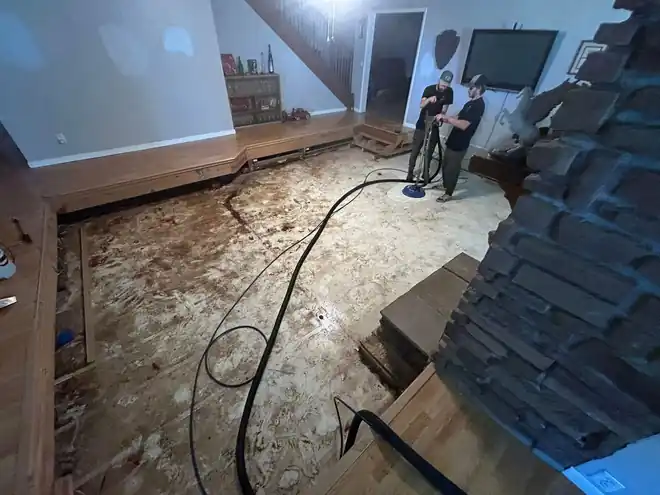
This side
The six steps of the dry-out.
- Emergency Water Extraction
- Structural Drying and Dehumidification
- Moisture Detection and Mapping
- Contaminated Water Cleanup (Category 2 and 3)
- Contents Drying and Protection
- Repair Coordination and Restoration
Then the rebuild side
Our own crew, same company.
- Flooring
Hardwood, laminate, vinyl and tile, laid on a subfloor that has been assessed and prepared first.
- Framing
Floor and wall framing repaired where water and moisture got into the structure.
- Kitchen Remodels
Cabinets, counters and floors put back when the kitchen was the room that flooded.
- Bathroom Remodels
Tile, fixtures and the ventilation that keeps the room dry afterward.