Mold after a leak: when it's a cleaning job and when it needs remediation
Where the growth is, what it's growing on and why it's there decide whether you wipe it or call a crew.
October 17, 2026 · 4 min read
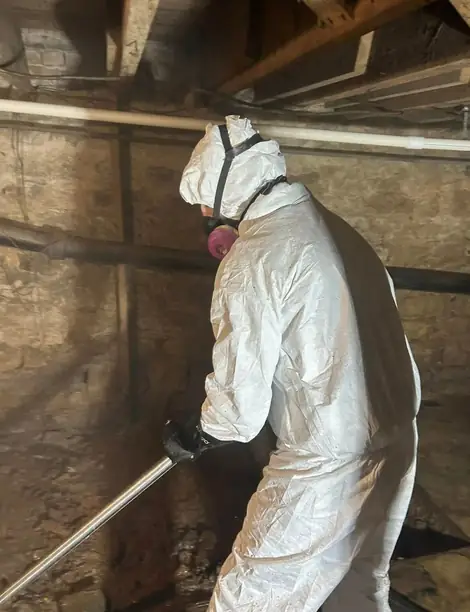
Mold usually follows moisture that stayed too long: a slow leak under a sink, a wall that got wet in a storm, a basement that never fully dried. Finding it raises an immediate question, which is whether you can wipe it off or whether it needs a crew. The answer depends on where it is, how much there is, what it's growing on and, above all, why it's there.
When it's a cleaning job
A small patch of surface growth on a hard, sealed surface is often a cleaning and moisture problem. Think of a tile corner, a painted wall that never got wet through or a window sill that collects condensation. Wipe it with detergent and water, dry the area completely and fix whatever keeps it damp, whether that is a drip, poor ventilation or a gap in the caulk. If it comes back, the moisture source was never solved.
Keep the cleaning gentle. Scrubbing hard or brushing dry growth can throw dust and spores into the air and spread the problem to rooms that were clean. If the wiping reveals more than you expected, such as a soft wall, a dark stain spreading past the original spot or a layer of growth behind the paint, stop and reassess.
Signs it needs more than a cleaning
- Growth on drywall, insulation, carpet, ceiling tile or other porous materials. They absorb it and can't be fully cleaned.
- A musty smell with no visible source, which often points to growth inside a wall, under flooring or above a ceiling.
- Growth across a large area, or growth that keeps returning after you clean it.
- Growth that followed a long-running leak, a flood or contaminated water.
- Growth in or near the HVAC system, where air can carry it through the house.
Any one of these means the job has moved past scrubbing. The material itself is part of the problem, and the work has to be planned so that it doesn't spread what's already there.
Containment protects the rest of the house
Mold that is disturbed carelessly can spread to clean areas. Remediation therefore starts with containment: plastic sheeting sealed around the work area, controlled airflow so air from the work zone doesn't drift through the house, and a plan for how people and materials move in and out.
At Quality Cleaning and Restoration, LLC, the mold remediation process includes containment measures to protect occupants during treatment. That is also why mold work on an occupied property is realistic: the work area is isolated, so the rest of the house can stay in use.
What a remediation job involves
The steps follow a logic. You find the problem, isolate it, take out what can't be saved, dry what can, and treat the rest.
- Inspection and assessment, to find where the growth is and how far it extends.
- Containment and air control around the work area.
- Safe removal of affected materials that can't be cleaned, bagged inside the containment.
- Structural drying and dehumidification, so the area stays dry after the work.
- Antimicrobial treatment of the surfaces that stay.
- Post-remediation verification.
The step that sits behind all of these is the moisture source. If the leak, the condensation or the grading problem that caused the growth isn't corrected, everything above will have to be repeated. A good crew will tell you what caused the moisture as well as what grew on it, and will say plainly if the fix belongs to a plumber or a roofer before the cleanup can last.
Post-remediation verification is the finish line
A work area that looks clean isn't necessarily finished. Verification is a check after the work, with documentation, that the area is actually clean and dry. It should confirm that moisture readings are back to normal, that there is no visible growth and that the musty smell is gone. Some situations also call for sampling. Ask what verification will be done and what you will receive in writing.
Verification matters for your own confidence, and it matters for any insurance claim attached to the loss. It gives you a record that the problem was handled instead of covered over.
Rebuilding afterward
Removing moldy drywall or flooring leaves open walls and bare subfloor. Quality Cleaning and Restoration, LLC rebuilds in-house, so the crew that removed the damaged material also handles the framing, drywall and finish work that follow. Nothing needs to be handed to a second company who wasn't there to see what was removed.
If you've found growth or a musty smell you can't explain, call (573) 631-8495 for a free estimate. The crew answers at any hour, any day of the week.
Quality Cleaning and Restoration, LLC, (573) 631-8495
Call (573) 631-8495More articles
What to do in the first hour after water gets into your house
A short sequence done in the right order limits the damage and protects your insurance claim at the same time.
Why a floor that looks dry can still be wet
Surface dryness is something you feel, while real dryness is something a crew measures and records.