Why a floor that looks dry can still be wet
Surface dryness is something you feel, while real dryness is something a crew measures and records.
October 17, 2026 · 4 min read
A floor can feel dry under your hand while the subfloor beneath it is still holding water. A wall can look perfectly normal while the insulation inside it is wet. This is the main reason a water loss that seemed small turns into warped flooring, stained drywall or mold weeks later. Dry to the touch is a surface observation. Dry is a measurement.
Water doesn't stay where it landed
Water follows the path of least resistance. It wicks upward into drywall and baseboards, runs along joists, soaks into subfloor seams and drops through the gaps around plumbing into the room below. Carpet pad holds water like a sponge, while the carpet on top may feel only slightly damp. Hardwood can take on moisture from underneath long before the surface shows any cupping. Insulation inside a wall cavity, once wet, can hold moisture against the framing and drywall with nothing to let it out.
That is why a visible wet spot is usually the smallest part of the picture. The job is to find the edges of the wet area rather than guess where they are.
The tools that find hidden moisture
Restoration crews use instruments so they aren't relying on touch and sight alone. Three of them do most of the work.
- Moisture meters. A pin or pinless meter reads moisture in materials like drywall, wood framing and subfloor, and gives the technician a number to track instead of an impression.
- Thermal imaging cameras. A wet surface often reads cooler than a dry one, so the camera shows patterns behind walls and under floors that the eye can't. It points to where to measure, and the meter confirms what is actually there.
- Hygrometers. These measure temperature and relative humidity in the air, which tells the crew whether the air in the space can still absorb moisture from the materials around it.
None of these is a magic wand on its own. Used together they cross-check each other, and that is what makes the findings reliable.
Moisture mapping gives the job a baseline
Moisture mapping means recording readings across the affected area, room by room and surface by surface, and marking where wet turns into dry. The map shows how far the water traveled, which materials can be dried in place and which are too saturated to save. It also sets a baseline. Without a starting point there is no way to tell whether the drying is working.
A good map is also the foundation of an insurance claim. Readings with locations and dates are documentation an adjuster can follow, and they keep the scope of work tied to something measured instead of something argued over.
How structural drying actually works
Drying a building is a controlled process. The goal is to move water out of the materials and into the air, and then pull it out of the air. A few kinds of equipment carry most of that work.
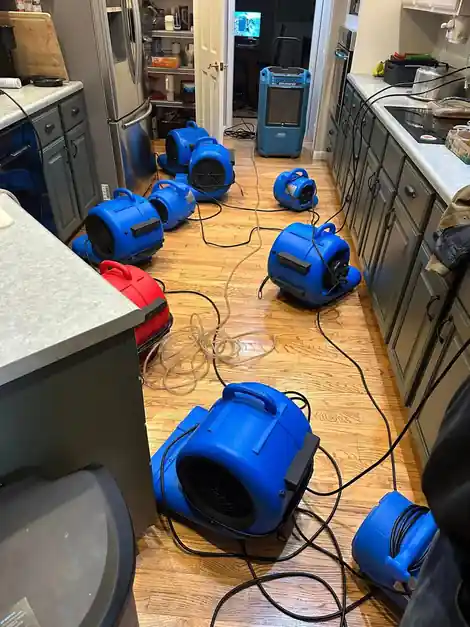
- Air movers push air across wet surfaces so moisture leaves the material and enters the air. Placement matters, because equipment aimed at the wrong surfaces dries the room while the wet framing stays wet.
- Dehumidifiers pull that moisture back out of the air so the air can keep absorbing more. Without them, humidity in a closed room climbs and the drying stalls.
- Targeted drying setups move air through wall cavities or under flooring, where open airflow can't reach.
Doors and windows are usually kept closed during structural drying. That surprises people, who expect to open everything up, but a closed space lets the dehumidifiers do their job. Opening it up can let humid outdoor air back in. It also explains the equipment. A kitchen full of fans and dehumidifiers is a drying plan in progress, not overkill.
Dry is a number you can check
The crew returns to take the same readings in the same places. Materials count as dry when they read like the same material in an unaffected part of the building, not when they feel dry. Equipment stays until the readings say it can go. Pulling it early is how a wall that tested wet comes back later as a stain or a smell.
When the numbers are down, the equipment comes out and rebuilding can start. A restoration company that also rebuilds has a clear reason to dry thoroughly. Quality Cleaning and Restoration, LLC has an in-house reconstruction crew, so the people closing those walls and laying new flooring are working over drying they can stand behind.
If water has been in your home and nobody has measured anything, ask for it. Call (573) 631-8495 for a free estimate, any day and any hour.
Quality Cleaning and Restoration, LLC, (573) 631-8495
Call (573) 631-8495More articles
What to do in the first hour after water gets into your house
A short sequence done in the right order limits the damage and protects your insurance claim at the same time.
Working with an insurance adjuster after a water, fire or mold loss
Organized documentation and a clear order of work make the claims process easier for you and for the adjuster.