What to do in the first hour after water gets into your house
A short sequence done in the right order limits the damage and protects your insurance claim at the same time.
October 17, 2026 · 4 min read
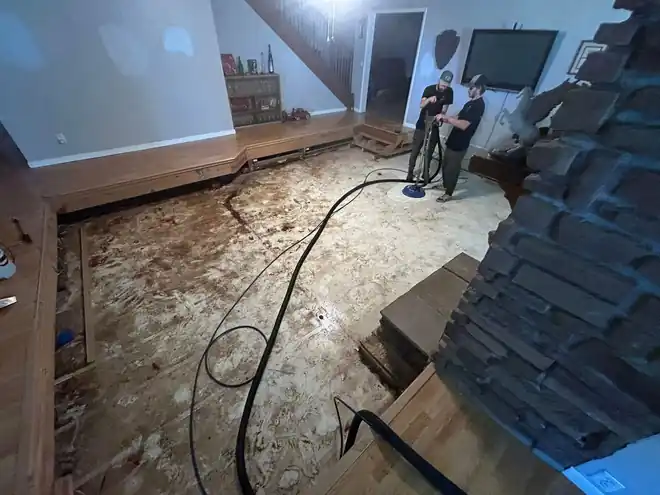
Water in the house sends most people straight to towels and buckets. The first hour is better spent on a short sequence: stop the water, make the area electrically safe, document what happened, protect what you can, and call for help. Do those in that order and you limit the damage while protecting your claim. It applies to a burst pipe, a failed supply line, a leaking water heater, a roof leak or storm water coming in.
Stop the source of the water
If the water is coming from a pipe, a water heater, a washing machine or a toilet supply line, find the shut-off and close it. Most fixtures have a small valve right at the fixture. If you can't find it or it won't turn, go to the main shut-off for the house, usually where the water line enters near the meter, along a basement wall or in a utility closet. Knowing where that valve is before you ever need it is one of the most useful things a homeowner can learn.
If the water is coming in from outside, through a roof or a wall, you can't shut it off. Your goal then is to keep it from spreading, so move on to the next steps. Don't climb onto a wet roof to patch it. Tarping a roof is work for people with the right gear and training.
Deal with electricity before anything else
Water and power are a dangerous combination, and the hazard is not always obvious. Water can run down through a ceiling into light fixtures, travel along wall cavities toward outlets and spread across a floor to a power strip. If water is near outlets, appliances, a panel or anything plugged in, treat the area as live.
- If you can reach the breaker panel without walking through water, switch off the breakers for the affected rooms. If the panel itself is wet or the floor around it is, don't touch it.
- Don't stand in water to unplug anything. Leave it and call an electrician or your utility if the situation isn't safe.
- Never run a household vacuum, a fan or an extension cord in standing water.
- If a ceiling is sagging or bulging with water, stay out from under it and keep children and pets away. Trapped water can bring down drywall without warning.
- If you smell burning or see sparks, leave the house and call 911.
Photograph and video everything before you move it
Your insurance claim will rest on what the damage looked like before cleanup began. Take photos and a slow walk-through video of every affected room, wide shots first and then close-ups. Capture the water line on the walls, wet ceilings, flooring, furniture and the contents of the room. If a pipe or appliance failed, photograph it. If you can reach the make and model labels on damaged appliances and electronics safely, photograph those too.
Then write down what you see and when you first noticed it. A short timeline kept on your phone is surprisingly useful later, when the details have blurred and someone asks what happened first.
Protect what you can, and leave the rest
Once the power question is settled and you can stand in the room safely, there is a short list of things worth doing right away.
- Lift small items, rugs, books, papers and electronics out of the water and onto a dry surface.
- Put foil or plastic squares under the legs of furniture you can't move, so wet legs don't stain the floor or carpet.
- Carry valuables, photographs and important documents to a dry room.
- Open windows only if the weather is dry and it's safe to do so. Otherwise leave them shut.
- Leave carpet, flooring, baseboards and drywall in place for a professional to evaluate.
Mistakes that make water damage worse
Good intentions cause a lot of secondary damage. These are the common ones.
- Running a household vacuum on wet carpet or standing water.
- Using a space heater or a hair dryer to speed up drying. It dries the surface and leaves the moisture inside the material.
- Walking through a flooded area where there could be live wiring or contaminated water.
- Throwing away damaged materials before they're photographed and before you've checked with your insurer.
- Waiting to see whether it dries on its own.
That last one matters more than it seems. Water moves into subfloors, wall cavities and insulation where you can't see it, and a surface that feels dry may be hiding wet material underneath. Mold and warped flooring are usually the result of water that was left in place, not water that was dealt with.
Call for help early
Call your insurance company to open a claim, and call a restoration company. Quality Cleaning and Restoration, LLC answers around the clock, seven days a week, and works with insurance adjusters on water losses. In Farmington and across southeast Missouri, you can reach them at (573) 631-8495.
When you call, say what happened, where the water is coming from, whether you've shut it off and whether any of it reached electrical equipment. The sooner a trained crew starts extracting water and drying the structure, the less there is to tear out and rebuild afterward.
Quality Cleaning and Restoration, LLC, (573) 631-8495
Call (573) 631-8495More articles
Why a floor that looks dry can still be wet
Surface dryness is something you feel, while real dryness is something a crew measures and records.
Working with an insurance adjuster after a water, fire or mold loss
Organized documentation and a clear order of work make the claims process easier for you and for the adjuster.